
Webinar Recording

Reframing the Talent Shortage in Regulated Industries Webinar

Catch the full discussion between Dan Crerand, John Shepherd, and Miguel Trenkel-Lopez on whether regulated industries face a talent shortage or an over-reliance on scarcity thinking.

The discussion looks at how these challenges affect the wider energy and critical infrastructure sectors, including the growing workforce demand across the nuclear new build supply chain.
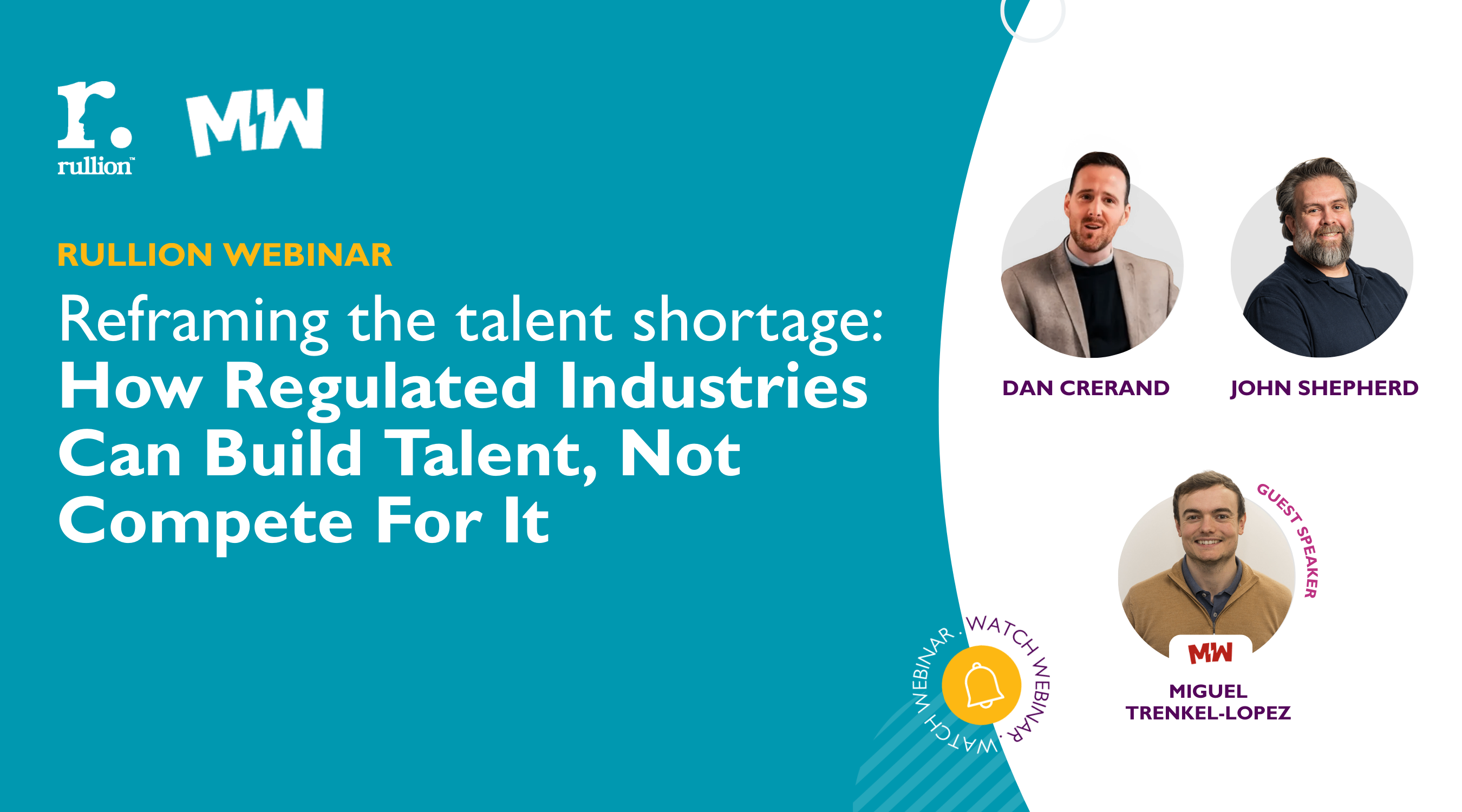
<h1><span style="color: rgb(84, 7, 91);">Reframing the Talent Shortage in Regulated Industries Webinar</span></h1>

The energy transition is accelerating, but the workforce needed to deliver it isn’t keeping pace.

Across the UK energy sector, organisations frequently point to a growing talent gap. From nuclear projects to renewable energy infrastructure, the demand for skilled professionals continues to rise faster than traditional hiring pipelines can supply them.

But what if the problem isn’t simply a talent shortage, but how the industry defines and accesses talent?

Featuring Miguel Trenkel-Lopez, Founder of Megawatt, and Rullion’s Train to Deploy Director, Dan Crearand, and Client Services Director for the Energy and Utilities industries, John Shepherd, our panel explored how shifting from a mindset of scarcity to one of abundance can help organisations rethink recruitment, attract new generations of talent, and unlock previously overlooked candidates.

Recording Timestamps

00:00 Introductions

02:59 Understanding the talent shortage challenge

05:08 Reframing the narrative: abundance vs. scarcity

11:28 Innovative approaches to talent acquisition

14:03 Megawatt: raising energy literacy through play

21:43 Train to Deploy: a new model for talent development

30:33 Q&A: practical solutions to talent challenges

31:18 The climate anxiety and job purpose connection

32:26 Bridging the gap: engaging young talent in energy

39:09 Tapping into hidden talent pools

41:00 Reframing recruitment: access and inclusivity in hiring

48:35 Integrating social value into business strategy

52:55 From scarcity to abundance mindset in energy sector

Closing remarks

Your questions answered

Here are a few of the questions we received from our audience:

There is undoubtedly a growing demand for skilled professionals across the energy sector, particularly in areas like nuclear, renewables, and power grid infrastructure. However, many organisations are beginning to recognise that the issue is not only a lack of talent, but how accessible those careers are to new entrants.

Broadening entry pathways by rethinking experience requirements and investing in training programmes can significantly expand the available talent pool.

The nuclear sector faces one of the most significant workforce challenges due to the scale of upcoming infrastructure projects.

Addressing the shortage requires a combination of strategies:

  • Expanding graduate and early-career pathways
  • Investing in retraining programmes for adjacent industries
  • Developing faster, more flexible training models
  • Building stronger partnerships between industry and education

Programmes designed to rapidly develop job-ready talent, like Train to Deploy can play an important role in accelerating workforce readiness.

Major nuclear infrastructure projects rely on a vast supply chain spanning engineering firms, specialist manufacturers, construction partners, and technical service providers. As the UK moves forward with nuclear new builds, the demand for skilled workers will extend across hundreds of organisations supporting these projects, as already seen with Hinkley Point C.

This means the nuclear workforce shortage cannot be solved by individual companies alone. Supply chain partners will need to work collaboratively to attract new talent, develop early careers pipelines, and invest in workforce training to ensure the sector has the capability required to deliver long-term critical infrastructure programmes like Sizewell C and the Rolls-Royce SMR.

Across the UK’s energy and infrastructure sectors, roughly one in three workers are aged over 50, highlighting the scale of the retirement cliff facing the industry just as demand for new skills continues to grow.

Replacing retiring expertise while supporting the transition to a low-carbon energy system means engaging younger generations is essential to maintaining the sector’s long-term capability.

Many younger professionals are motivated by purpose and impact. Connecting careers in energy to climate solutions, sustainability, and real-world innovation can make the sector far more visible and appealing.

Organisations can help attract the next generation by:

  • Improving energy literacy
  • Highlighting the range of roles available
  • Showing clear pathways into critical infrastructure industries

Access is one of the most powerful ways to address the talent gap. By expanding recruitment beyond traditional pipelines and considering candidates from different backgrounds, industries, and career stages, organisations can unlock new sources of talent that might otherwise be overlooked.

Inclusive hiring practices help address the structural causes of the UK skills shortage just as much as they support diversity.

Key takeaways

To address the talent shortage, regulated industries like the energy sector needs to adopt an abundance mindset

The talent shortage narrative may be limiting progress

While demand for skilled professionals is rising across many regulated industries, focusing only on talent scarcity can prevent organisations from recognising untapped talent pools.

Access matters as much as skills

Traditional hiring requirements exclude many potential candidates. Expanding early careers pathways, apprenticeships, and entry-level routes into the industry can unlock access to multiple avenues of talent that might otherwise be overlooked.

Purpose attracts the next generation

Younger professionals are often motivated by work that connects to climate solutions and real-world impact. Initiatives that improve energy literacy, such as educational tools like Megawatt, can help make the sector more visible and accessible to future talent.

Training models need to evolve

Traditional education pathways alone cannot meet the pace of workforce demand. Workforce development models such as Train to Deploy show how organisations can invest in structured training that develops the specific skills needed for critical infrastructure roles.

Collaboration across industry is essential

Addressing the nuclear workforce shortage and wider skills gap will require collaboration between employers, educators, and training providers to create new entry routes and scalable training solutions.

An abundance mindset unlocks talent opportunities

By shifting the narrative from shortage to possibility, organisations can identify new ways to attract, train, and retain talent.

Train to Deploy Toolkit

Build your future workforce sustainably

Solving the energy sector’s talent challenges requires more than traditional hiring approaches. The Train to Deploy toolkit is a great first step in exploring how organisations like yours can accelerate workforce development, reduce hiring risk, and build sustainable talent pipelines.
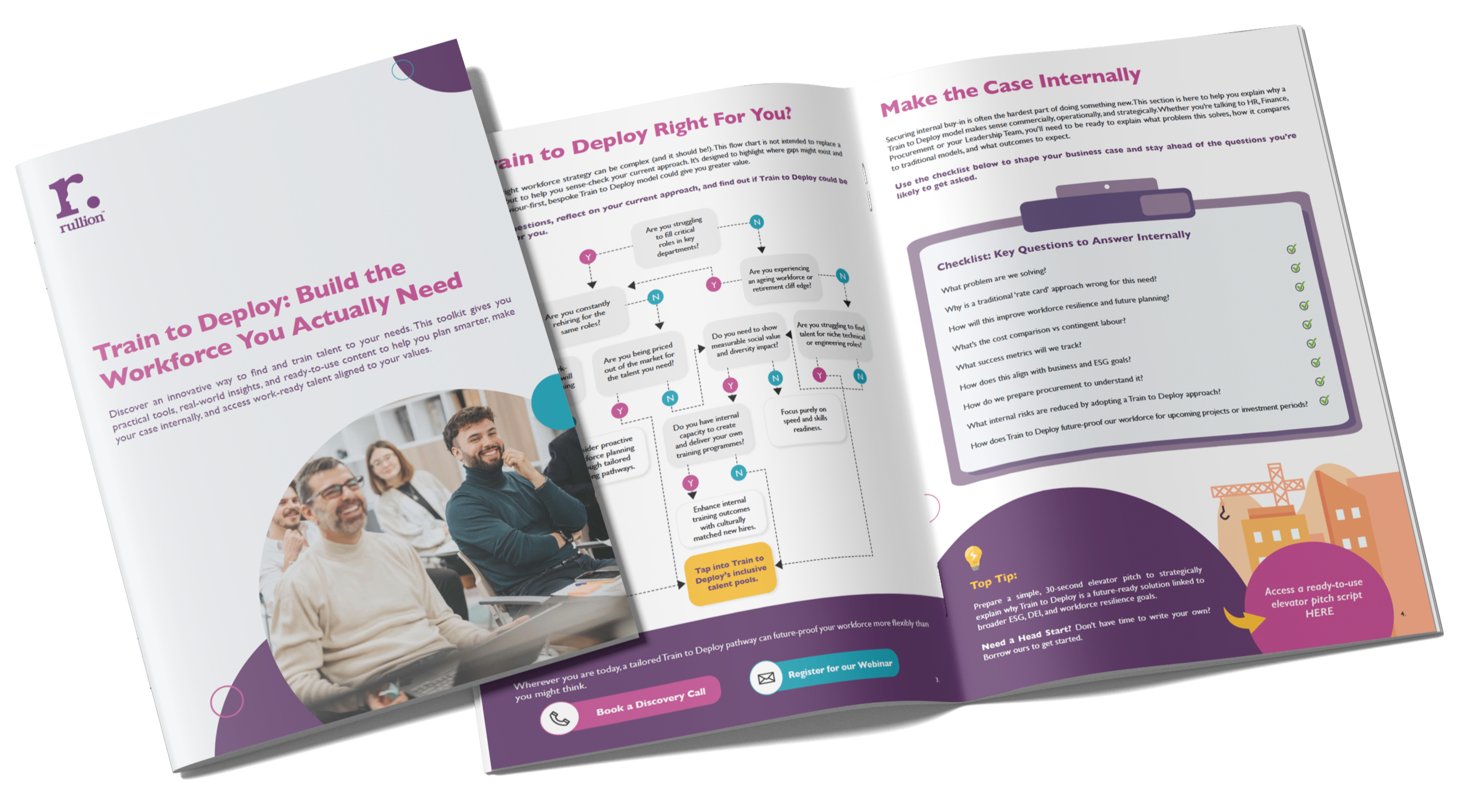
<h2>Build your future workforce <span style="color: rgb(189, 51, 131);">sustainably</span></h2>

Continue the conversation

For organisations looking to go further, John Shepherd works with employers across energy, nuclear, and critical infrastructure to explore workforce challenges and design solutions that build long-term capability.


What's on your mind?

Our insights and tips on some of your most burning questions

BLOG
5 Signs Your Workforce Needs a Train to Deploy Strategy

5 Signs Your Workforce Needs a Train to Deploy Strategy

You need a Train to Deploy Strategy when you find yourself: Rehiring the same roles repeatedly Staring down a retirement cliff Watching time-to-hire stall delivery Falling behind on diversity and social value Working with out of sync training providers Train to Deploy, often referred to as a Hire Train Deploy or a Recruit Train Deploy model, is a workforce transformation solution where a provider designs, delivers, and deploys role-specific training up front, helping you plug skills gaps, onboard faster, and build work-ready teams from day one. This is typically done by bringing in transferable talent from adjacent sectors, reskilling deployed contractors, or hiring and training new external candidates aligned with your business goals. Most organisations don’t always realise when they’re ready for a Train to Deploy (TTD) strategy. The signs build gradually. Recruitment pressures intensify quietly. Talent pools shrink. Skills gaps start to feel permanent. And the tools that once worked – your job boards, agencies, and graduate deployment schemes – no longer deliver the talent or speed you need. If any of this feels familiar, you're not without options. A Train to Deploy strategy can help you rebuild confidence in your workforce plan, expand your reach, and reduce the hidden costs of reactive hiring. It’s one of the most effective ways to evolve your talent pipeline strategy to build scalable, work-ready teams. Here are five signs that now might be the right time to make the shift. 1. You’re Rehiring the Same Roles Repeatedly When roles start to become revolving doors, it’s often a sign that the problem isn’t just recruitment; it’s readiness. High turnover in key positions can point to poor role fit, lack of structured development, or unclear progression pathways. It burns through recruitment budgets, disrupts project continuity, and stalls long-term growth. TTD flips the traditional model on its head. Instead of waiting for the “right” person to appear, you develop the capabilities you need within the people you hire or redeploy from day one. Rullion’s match-to-train approach directly addresses the root cause by designing role-specific training and onboarding ahead of deployment, ensuring the people coming into your organisation are better equipped, aligned, and more likely to stay. You’re building the talent you need, sustainably. 2. You’re Staring Down a Retirement Cliff In critical infrastructure sectors, retirements are accelerating. In the UK energy and utilities sectors alone, 37% of the workforce will retire by 2030 – that’s around 168,400 vacancies that will need to be filled. And with them, decades of knowledge are walking out the door. Our train and deploy solution bridges that gap before it opens. We help you upskill successors, build structured handovers, and onboard people who can shadow, learn, and grow into critical roles. We make sure that expertise isn’t lost. It’s transferred, evolved, and retained. 3. You’re Watching Time-to-Hire Stall Delivery Every week you wait for a hire to land is a week your teams aren’t delivering. In project-based environments, those delays cascade into missed milestones, overstretched teams, and lost momentum. A Hire Train Deploy strategy eliminates that lag. With custom training and onboarding ahead of deployment, candidates arrive equipped with the technical and behavioural readiness to contribute from day one. That upfront investment in preparation pays dividends in retention, and not just in performance. When new hires feel supported, skilled, and set up to succeed, they’re far more likely to stay. 4. You’re Falling Behind on Your Diversity and Social Value Goals Most organisations have diversity targets and social value commitments, but traditional hiring often reaches the same narrow pools in the same ways. Rullion’s Train to Deploy solution is built around inclusion without limits. If someone shows the right mindset, behaviours, and potential, we build the skillset, regardless of their background or circumstance. We don’t tick boxes or run generic ED&I programmes. We focus on opening doors to those with potential and create genuinely inclusive talent pipelines that reflect the communities you serve. 5. Your Training Providers Feel Out of Sync As your organisation adapts to new technologies, delivery models, and regulatory changes, you need learning partners that can evolve just as fast. But many traditional training providers are slow to respond. Courses feel outdated, generic, or disconnected from the realities your teams face day-to-day. This disconnect leads to wasted investment, delayed impact, and talent that still isn’t ready for the job. If your current provision feels out of sync, Rullion’s Train to Deploy strategy gives you control. You co-design the training journey to reflect your systems, tools, and standards, and we manage delivery, acting as the conduit between you and the training providers. We help embed learning into your operating model, whether through bespoke external programmes or scaling your own internal training. Making sure your people are learning what matters and applying it from day one. Recognising the Signs Every workforce challenge is an opportunity to rethink the way things have always been done. If any of these signs sound familiar, it may be time to reassess your approach. A Train to Deploy strategy offers a more proactive path, helping you build the skills, teams, and resilience you need to grow. Shift from reactive hiring to long-term capability building. And get ahead of change before talent gaps hold you back. Helping you get work done Visit our Train to Deploy solution page to see how a Train to Deploy strategy could work for your organisation or book a discovery call with one of our consultants.

By Rullion on 21 July 2025

BLOG
Building a Business Case for a Train to Deploy Workforce Strategy

Building a Business Case for a Train to Deploy Workforce Strategy

What is a Train to Deploy Workforce Strategy? Train to Deploy is a scalable, future-focused workforce solution. It replaces legacy recruitment with a sustainable approach that combines behaviour-first hiring with bespoke, role-specific training, enabling you to deploy work-ready people aligned with your business from day one. Here’s how to position a Train to Deploy workforce strategy as the strategic answer your business needs now. Step 1: Define the Problem Clearly Before you pitch a solution, your first job is to make the cost of doing nothing impossible to ignore. Here are 5 signs your workforce needs a Train to Deploy strategy to get you started. Use hard data to show where your current hiring model is falling short and what that’s costing you. Start by asking questions your leaders will care about: Skills gaps Are the same roles being readvertised month after month? Are niche capabilities slowing or stalling project delivery? Is critical knowledge walking out the door as retirements rise? Project risk Are high vacancy rates impacting timelines and team cohesion? Do long onboarding periods stall delivery and productivity? Can your team scale quickly enough for upcoming project peaks? If time-to-hire is 45+ days and onboarding takes another 30+ days, how much delivery time are you losing? Diversity gaps Are legacy hiring filters limiting access to diverse, high-potential candidates? Are you falling short on DEI or ESG bid requirements in public sector or regulated tenders? Do you lack scalable, measurable programmes to attract, develop, and retain under-represented talent? Step 2: Quantify the Cost of Inaction Your goal is to then articulate the long-term risks of continuing with business as usual. To get stakeholder buy-in, you need to frame the commercial impact of inaction. Make sure you define both direct costs and knock-on consequences of not addressing your current approach. Recruitment costs Add up your full cost per hire: agency fees, internal resource time, readvertising, interview panels, onboarding, and early attrition. The average cost per hire in the UK is £3,000–£5,000. For 30 hires per year, that’s £90K - £150K before you account for the cost of replacing those who leave early. Then factor in: First-year attrition Contractor spend to plug gaps Time-to-productivity lag with ramp-up times resulting in value not being delivered Productivity loss and project delays Every week a role remains unfilled, you lose delivery hours. Every month a new hire is onboarding, and your project velocity drops. Delayed milestones = missed SLAs or penalty clauses Lost momentum = increased risk of burnout in stretched teams Lower team efficiency = knock-on delays in other workstreams Even a 10-day hiring delay across 5 projects can equate to hundreds of lost delivery hours or tens of thousands in opportunity cost. Missed ESG & social value metrics For public sector frameworks and many regulated sectors, bids require proof of community investment and inclusive hiring. If you’re failing to demonstrate social value or provide measurable DEI outcomes, you could be missing out on commercial opportunities. Step 3: Train to Deploy Proposition Once you’ve demonstrated the cost of inaction, you’ll need to demonstrate how a Train to Deploy workforce strategy can address the real problem. Your workforce model no longer fits today’s reality. Behaviour-first sourcing Instead of relying on CVs and past job titles, Train to Deploy starts with what really matters: mindset, adaptability, learning agility, and culture fit. How it solves the problem: Increases retention by hiring based on long-term fit; when people align with your values and environment from day one, they’re more likely to stay long term. Helps de-risk hiring by aligning people to your ways of working before they start TTD solutions remove traditional hiring barriers, opening doors to all those able to demonstrate the right behaviours and potential, regardless of their background or circumstances. We call this “inclusion without limits”: if someone has the right behaviours, we build the skillset. Bespoke, role-aligned training A Train to Deploy programme delivers tailored technical development, embedding the systems, standards, and compliance frameworks your teams use day-to-day. How it solves the problem: It simplifies procurement with one contract and one partner, with complete visibility. Shortens onboarding time as readiness is built into the training Increases long-term capability with all hires being trained to the same standards and expectations as your existing teams. Meaning less need for post-hire correction, shadowing, or retraining. New hires start work with the right frameworks, protocols, and requirements, improving compliance and operational risk. We co-design the training with you and act as a conduit between your business and training providers while managing the heavy lifting of sourcing, screening, training, deployment, and mentoring. Deploying work-ready talent After training, talent is deployed directly into your team, already aligned with your culture, systems, and technical needs. The transition is seamless because we’ve already embedded your systems, culture, and team dynamics into their preparation. We also offer mentoring and coaching during deployment to support success. The benefits: Enables faster productivity and better collaboration Builds confidence and cohesion in high-stakes environments Supports smoother team integration and day-one impact Scalable, predictable talent pipelines With TTD, rather than reacting to workforce gaps, you’re building capability in anticipation of future need. Whether for seasonal peaks, project launches, or expansion into new capabilities, you can scale talent development in line with strategic goals. The benefits: Reduces contractor reliance by developing permanent, aligned talent Smooths hiring cycles with a predictable, flexible pipeline Helps you respond faster to new project requirements or capability shifts Step 4: Anticipate Stakeholder Priorities Your case needs to work across commercial, operational, and organisational priorities. Read our quick rundown of the ROI of building talent internally. Here’s how to tailor your message to what matters most to each stakeholder: Finance Long-term cost avoidance with fewer agency fees, less attrition/higher retention, fewer cycles of rehiring, and reduced onboarding lag Reduced dependency on costly contractors with internal pipeline Long-term cost predictability and spend control through a single all-in solution “We can reduce agency costs by 30–50% and improve first-year retention by 40% with a Train to Deploy workforce strategy.” Procurement Ability to consolidate vendor management with one trusted supplier managing sourcing, training, and deployment Alignment with existing workforce, training frameworks, and compliance with industry and safety regulations Commercial flexibility to scale up or down based on needs Operations Highlight reduced time-to-productivity and onboarding lag with bespoke training embedding tools and systems into learning Readiness in safety-critical and regulated environments through training Demonstrate retaining institutional knowledge through structured training, shadowing, and handovers Highlight reduced dependency on external contractors with an aligned, trained internal pipeline CSR / DEI Leads Inclusion with real impact on career switchers, returners, veterans, and under-represented communities Measurable progress on social value targets through inclusive pathways Position TTD as truly inclusive hiring. Rullion’s model focuses on “inclusion without limits”; the door is open to all those who have the right behaviours and potential. Step 5: Building a Clear Case for Change Reframe the narrative from patching your hiring process to building capability for the future. This can help shift the conversation from “Why would we?” to “Why wouldn’t we?” Current Approach Train to Deploy Plugging gaps Building long-term capability Spending reactively Investing in readiness Chasing CVs Developing aligned, inclusive talent Onboarding after hiring Delivery work-ready teams from day one

By Rullion on 25 August 2025

BLOG
Building Talent, Not Buying It: A Smarter Workforce Strategy

Building Talent, Not Buying It: A Smarter Workforce Strategy

Traditional hiring models are increasingly struggling to meet the needs of modern organisations. Many critical infrastructure organisations across sectors like energy, transport, and utilities are hitting the same wall: rising recruitment costs, critical skills shortages, and new hires who struggle to adapt quickly enough to complex working environments. While external recruitment will always have its place, it’s no longer enough on its own. It’s time to consider more balanced, sustainable approaches, like Train to Deploy (TTD), a workforce transformation model that enables organisations to look at retraining and growing the talent they need, reduce risk, and create more resilient teams. What’s broken with the "Buy Talent" Model? For years, the default hiring strategy has been reactive: hire fast, fill the gap, and hope it sticks. But for many organisations, that model is now showing cracks: Niche skills are increasingly hard to find The cost of contingent labour is rising New hires often struggle with cultural fit or lack the hands-on readiness needed Scarcity of Niche Skills Whether it’s engineers in nuclear, software talent in tech, or skilled operatives in mechanical and electrical sectors, niche capabilities are becoming harder to source. As infrastructure projects grow in complexity and the transition to renewables accelerates, demand is far outpacing supply. This skills gap creates a bottleneck for delivery, drives up competition, and increases your exposure to project delays and rising costs. High Recruitment Costs Traditional hiring methods come with a hefty price tag – recruitment agency fees, advertising, vetting all the candidates, and onboarding – they all add up. And when hires don’t work out, the cost of starting over is even higher. In sectors managing large-scale infrastructure or utilities programmes, this cycle of churn can undermine everything from workforce morale to project timelines and long-term planning. Cultural Misalignment Technical expertise doesn’t guarantee success, especially in complex environments like energy sites, control rooms, or high-stake multi-contractor projects. If new hires struggle to adapt culturally or operationally, productivity dips, safety risks rise, and team dynamics suffer. What "Building Talent" Really Looks Like Behaviour-First Hiring Traditional recruitment filters for qualifications and past experience. But this method often misses high-potential individuals who could thrive with the right development. Unlike other Hire Train Deploy models, Rullion’s Train to Deploy solution rethinks what makes someone the right fit and hiring for potential. Using behaviour-first hiring, or a train-to-match approach, Rullion focuses on mindset, adaptability, capability, and learning agility. In sectors like utilities, transport, and rail where on-the-ground collaboration is key, this approach helps to de-risk the process by bringing in talent that aligns with your organisational values, then upskilling or reskilling them in the technical areas your teams actually need. Tailored Technical Development Instead of waiting for the perfect candidate to emerge from the market, organisations can look to invest in upskilling and reskilling their existing teams to meet their specific business needs. Tailored development ensures training mirrors your actual operational requirements, right down to systems, tools, and standards. It’s a core step in delivering effective workforce transformation, ensuring your teams are equipped with the exact capabilities needed to perform and progress. Long-Term Workforce Resilience Organisations that build from within and invest in their people are far more resilient. When employees grow alongside the organisation, they develop deeper institutional knowledge and the ability to flex as priorities shift. This approach promotes long-term retention and creates a stable, adaptable workforce ready to meet future challenges head-on. Why Train to Deploy is Different Custom Workforce Pathways Every business, site, and sector is different. What works in a retail logistics site won’t work in a nuclear-grade facility. Rullion’s TTD model adapts to your reality. They co-design specific training and workforce development pathways which you have full visibility over; this gives you full control in aligning training modules with your unique business objectives and challenges. Rullion does the heavy lifting, and you get work-ready people who have developed the exact skills and knowledge your company needs. A Faster Route to Workforce Readiness One of the key benefits of TTD services is its ability to rapidly prepare employees for new roles. While it may not be about “faster deployment” in the traditional sense, train and deploy solutions offer a quicker route to workforce readiness by focusing on specific, targeted skills development. This leads to a more efficient onboarding process and a workforce that is ready to contribute from day one, without the typical lag time that comes with traditional recruitment. As part of a wider workforce transformation effort, this accelerated readiness helps organisations meet evolving demands without compromising on quality, safety, or team cohesion. It’s a smarter ramp-up for complex environments where getting it right the first-time matters. Social Value and Diversity Built-In A key value of TTD is its ability to break down traditional barriers and broaden access to talent. Rullion believes in inclusion without limits. If someone can demonstrate they’ve got the right mindset and behaviours, then Rullion will build the skillset, regardless of what role or industry that person previously worked in. This means that their Train to Deploy approach is capable of building truly inclusive talent pools, holding the doors open to those with the potential to thrive, regardless of their situation. This is the power of a real workforce transformation strategy, giving organisations the opportunity to do things differently while strategically expanding their talent pool to better reflect the communities and industries they serve. It creates scalable, inclusive, and resilient workforces ready to meet the demands of tomorrow. Building the For the Future, Not Just Today Organisations need more than just quick fixes to their talent challenges. The future of workforce development lies in building talent from within, investing in the potential of existing employees and creating an environment where growth and adaptability thrive. Train to Deploy (TTD) provides a clear, sustainable path to achieving this. It’s a workforce transformation model designed to reduce reliance on external recruitment while building resilient, high-performing teams that keep your organisation ahead of the curve. Want to explore how train to deploy could work for your sector? Visit Rullion’s Train to Deploy solution page or book a discovery call with one of their consultants to see how Rullion can help you get work done.

By Rullion on 22 May 2025